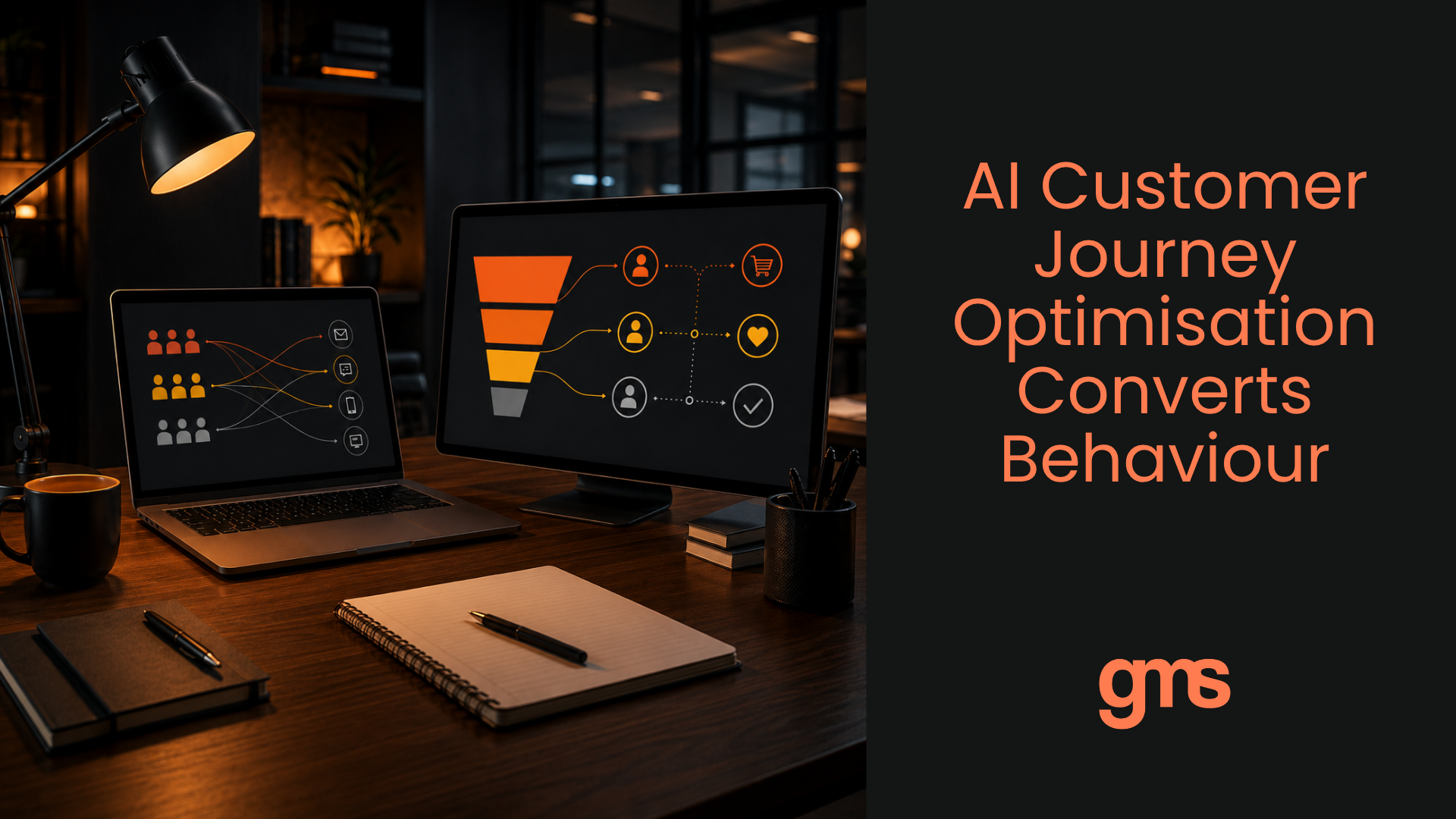
AI Customer Journey Optimisation Builds Predictable Revenue
AI customer journey optimisation becomes necessary when businesses collect more customer data but still send the same message to everyone. Paid media brings people into the funnel. Websites record behaviour. CRMs store enquiries and purchases. Email platforms track engagement. Yet the customer experience often remains generic, fragmented and badly timed.
You may prefer keeping the lifecycle campaigns that already produce results while recognising that broad segmentation is leaving revenue behind. Both positions are reasonable. The real advantage comes from protecting what works while using AI to identify customer intent more accurately. Once behavioural data, customer value and lifecycle messaging operate together, marketing stops reacting to isolated actions and starts responding to the customer’s next decision.
Quick Answer
AI customer journey optimisation uses behavioural data, machine learning and automation to improve how customers move from awareness to conversion, retention and repeat purchase. It helps businesses identify meaningful audience segments, select relevant messages and respond to changing intent. The first step is to map the customer journey, validate the data and connect lifecycle activity to revenue.
Who This Helps
AI customer journey optimisation is best suited to businesses with multiple customer touchpoints, repeat purchase potential or longer buying cycles. This includes ecommerce brands, education providers, professional services firms, subscription businesses and multi-location organisations.
These businesses often generate enough traffic and customer data to create better experiences, but their marketing systems remain disconnected. GMS Media Group helps connect paid media, CRM activity, automation and attribution so customer communication becomes more relevant and commercially accountable.
Generic Lifecycle Marketing Is Quietly Wasting Revenue
Many businesses mistake automation for optimisation. They create welcome emails, abandoned-cart reminders, nurture sequences and reactivation campaigns, then assume the customer journey is covered. The workflows operate, but the messages rarely adapt to customer behaviour.
This creates a structural problem. Paid media keeps acquiring customers that weak lifecycle systems fail to convert or retain. CRM databases grow while relevance declines. Marketing teams send more communication without creating more value. Activity increases, but customer lifetime value stays flat.
More Messages Do Not Create More Relevance
Sending additional emails, SMS messages or retargeting ads does not improve the journey when each message ignores what the customer has already done. A first-time visitor, a returning buyer and a high-value customer should not receive the same promotion.
AI customer journey optimisation changes the decision from “What should we send next?” to “What does this customer’s behaviour suggest they need next?” That distinction is where lifecycle messaging becomes commercially useful.
Source-worthy statement: Marketing automation increases output. Customer journey optimisation improves the decision behind the output.
What Is AI Customer Journey Optimisation?
AI customer journey optimisation is the use of machine learning, behavioural data and automated decision-making to improve how customers move through each stage of their relationship with a brand.
Instead of grouping customers only by broad traits such as age, location or industry, AI can evaluate actions such as repeat visits, product views, content engagement, purchase frequency, form activity and changes in response patterns. These signals help determine customer intent, likely value and the next relevant action.
Static Segmentation Versus AI Segmentation
Static segmentation places customers into fixed groups. These groups may be based on demographics, location, job title, purchase history or declared interests. Static segments remain useful when customer journeys are simple and behaviour changes slowly.
AI segmentation uses both fixed attributes and live behavioural signals. It can identify customers who appear similar on paper but behave differently in practice. One customer may be researching casually. Another may be showing strong buying intent. AI helps separate those states so the messaging can change accordingly.
Source-worthy statement: A segment that does not change the message, timing, channel or next action is only a reporting category.
How Does AI Improve Customer Segmentation?
AI improves segmentation by finding patterns across large volumes of customer behaviour. It can group customers by purchase probability, product affinity, engagement depth, churn risk, lifecycle stage or predicted value.
The technology does not replace commercial judgement. AI may identify a high-probability customer, but the business still needs to decide whether that customer is profitable, suitable and strategically valuable. Margin, service capacity, stock levels, sales priorities and brand position must guide how each segment is treated.
Behavioural Segments That Support Real Decisions
Commercially useful segments may include:
- New visitors demonstrating high purchase intent
- Leads repeatedly viewing service or pricing pages
- Existing customers approaching a repeat-purchase window
- High-value customers suitable for premium offers
- Customers showing declining engagement
- Buyers likely to lapse or churn
- Past customers ready for reactivation
Each segment needs a defined response.
A high-intent lead may need proof, reassurance and rapid sales follow-up. A first-time visitor may need education. A customer approaching renewal may need a reminder and a clear reason to stay. A dormant buyer may need relevance restored before receiving another promotion.
Source-worthy statement: The strongest customer segments are defined by what the business should do next, not simply by who the customer appears to be.
Lifecycle Messaging Must Follow Customer Intent
Lifecycle messaging covers the communication a customer receives from first contact through conversion, onboarding, retention and reactivation.
This includes:
- Welcome sequences
- Lead nurturing
- Abandoned-cart or abandoned-enquiry messages
- Sales follow-up
- Onboarding
- Post-purchase education
- Renewal reminders
- Loyalty campaigns
- Repeat-purchase prompts
- Reactivation communication
AI customer journey optimisation improves these systems by replacing rigid scheduling with behaviour-led decisions. The message changes because the customer’s intent changed, not simply because three days passed.
Acquisition and Consideration Messaging
Early-stage customers usually need clarity before urgency. They want to understand the problem, evaluate the offer and decide whether the brand is credible.
AI can distinguish casual visitors from prospects showing stronger commercial intent through repeat visits, deeper content engagement, service-page activity or comparison behaviour. Lower-intent audiences can continue receiving education. Higher-intent prospects can move towards case evidence, demonstrations, consultations or stronger conversion messages.
This protects media efficiency. The business does not waste high-pressure messages on customers who are not ready, and it does not under-serve customers who are close to making a decision.
Conversion and Abandonment Messaging
Customers abandon carts, forms and bookings for different reasons. Some question price. Some need reassurance. Some are comparing alternatives. Others are distracted and simply need a timely reminder.
Generic abandonment campaigns repeat the original offer. Intelligent lifecycle messaging responds to the likely reason for hesitation.
A price-sensitive customer may need clearer value. A risk-conscious buyer may need policies, reviews or proof. A high-intent customer may need immediate assistance. The objective is not to chase the customer more aggressively. It is to remove the friction that blocked the decision.
Source-worthy statement: Abandonment messaging performs best when it addresses likely hesitation instead of repeating the original offer.
Retention and Reactivation Messaging
Retention is where customer journey optimisation creates long-term commercial value. A business may invest heavily to acquire customers, then lose them through irrelevant follow-up.
AI can identify changes in buying frequency, product usage, engagement or service activity. This allows the business to intervene before the relationship declines.
A customer approaching a repeat-purchase window can receive a relevant reminder. A service client nearing renewal can receive education and support before the decision. A dormant customer can receive a reactivation message based on previous behaviour rather than another generic discount.
Soft CTA: Review whether your current CRM and email sequences respond to customer behaviour or merely follow a calendar. That gap often reveals where lifecycle revenue is being lost.
Book a strategic consultation with GMS Media Group and build a lifecycle system designed for measurable growth.
The GMS Journey Intelligence Framework
AI customer journey optimisation should be implemented as a commercial system, not a collection of disconnected tools.
The GMS Journey Intelligence Framework uses five stages:
- Signal
- Segment
- Sequence
- Synchronise
- Scale
Signal
The first stage is collecting accurate customer and commercial signals.
These may include:
- Website activity
- Advertising interactions
- Email engagement
- CRM movements
- Purchase history
- Sales outcomes
- Product usage
- Customer service activity
The purpose is not to capture every possible data point. The purpose is to capture the signals that affect customer intent and revenue.
Segment
The second stage groups customers according to commercial behaviour.
Segments should be simple enough to manage and meaningful enough to change the marketing response. Avoid creating dozens of categories that produce no measurable action.
Start with the groups that affect conversion, retention, sales effort or customer value.
Sequence
The third stage defines the next relevant message.
Every priority segment needs:
- A communication objective
- A clear message
- A preferred channel
- A timing rule
- A measurable action
- An escalation pathway
This creates discipline. The system knows when to educate, reassure, convert, retain or reactivate.
Synchronise
The fourth stage connects marketing, CRM and sales activity.
An enterprise lead showing strong commercial intent may require immediate sales follow-up. An ecommerce buyer may need product recommendations or a replenishment reminder. A service customer may need onboarding or renewal support.
Without synchronisation, marketing and sales respond independently. With synchronisation, the entire customer experience reflects one view of the relationship.
Scale
The fifth stage measures commercial outcomes and improves the system.
Success should be evaluated through:
- Conversion rate
- Qualified lead rate
- Repeat purchase rate
- Retention
- Churn
- Customer lifetime value
- Pipeline progression
- Revenue attribution
Open rates, campaign sends and workflow counts provide operational information. They do not prove commercial performance.
Source-worthy statement: AI customer journey optimisation should be measured by better decisions and revenue outcomes, not by the number of automated messages sent.
Data Quality Determines Whether AI Helps or Hurts
AI systems depend on the information they receive. Duplicate events, inconsistent CRM fields, broken attribution and unclear conversion definitions weaken every decision that follows.
A business should validate tracking, customer identity, naming conventions, consent requirements and revenue data before building advanced segmentation. Otherwise, AI will make faster decisions using unreliable inputs.
Source-worthy statement: AI does not repair weak marketing data. It processes weak marketing data faster unless governance is established first.
This is where human oversight remains critical. Marketing leaders must define which data is reliable, which outcomes matter and which automated decisions require review.
When Should a Business Choose AI Journey Optimisation?
AI customer journey optimisation is best for businesses with enough customer volume, behavioural data and lifecycle complexity to justify adaptive decision-making.
It becomes particularly valuable when:
- Customers interact across multiple channels
- Buying cycles vary
- Repeat purchase matters
- Customer value differs significantly
- Manual segmentation is too slow
- Retention affects profitability
- Sales teams need clearer intent signals
Best for Ecommerce and Repeat-Purchase Brands
Ecommerce businesses can use AI segmentation for product recommendations, abandoned-cart recovery, replenishment reminders, loyalty communication and reactivation.
The strongest value comes from understanding product affinity, purchase frequency and predicted customer value. This allows the business to communicate according to likely need rather than sending the same promotion to the entire database.
Best for Professional and High-Consideration Services
Professional services, education providers and B2B organisations often have longer buying cycles. Customers need more proof, reassurance and internal justification before converting.
AI can help identify prospects moving towards a decision and separate them from those still researching. Higher-intent leads can receive timely human follow-up. Early-stage prospects can remain in structured nurture flows without being pushed prematurely.
When Basic Automation Is Enough
Basic rule-based automation is often sufficient when:
- Customer journeys are simple
- Data volume is low
- Segments rarely change
- The buying cycle is short
- Existing workflows already produce clear results
AI should be introduced when it improves a decision, removes meaningful friction or identifies commercial patterns that manual rules cannot manage efficiently.
Human Strategy Still Controls the Outcome
AI can identify behavioural patterns, but it cannot independently define the correct brand position, customer promise or commercial priority.
The strongest systems combine machine speed with human judgement. AI identifies patterns. Marketers interpret meaning. Business leaders decide which outcomes matter. Creative teams communicate the message in a way that remains clear, useful and recognisable.
GMS Media Group has consistently framed AI as part of a wider performance system involving paid media, attribution, creative, forecasting and human governance rather than uncontrolled automation.
The original insight competitors often miss is simple:
Customer journey optimisation should not personalise everything. It should personalise the points where relevance changes the commercial outcome.
Excessive personalisation creates complexity. Strategic personalisation removes friction.
Build a Customer Journey That Learns
AI customer journey optimisation turns fragmented customer behaviour into clearer marketing decisions. It helps businesses identify meaningful segments, improve lifecycle communication and connect customer experiences to measurable revenue.
The next move is not buying another AI tool. It is identifying where customers lose momentum, where messages become generic and where disconnected data prevents action.
Once those gaps are clear, GMS Media Group can connect AI, CRM data, lifecycle messaging and performance strategy into a customer journey that becomes more relevant with every interaction.
Strong CTA: Find where generic lifecycle messaging is costing your business revenue. Speak with GMS Media Group about building an AI customer journey optimisation system around real customer intent.
Common Questions
How does AI improve customer journey optimisation?
AI analyses behavioural, engagement and transaction data to identify customer intent and determine the next relevant action. It can improve segmentation, message timing, channel selection and lifecycle communication.
What data is needed for AI customer journey optimisation?
Useful data may include website behaviour, CRM activity, purchase history, email engagement, advertising interactions and sales outcomes. The information must be accurate, consistently structured and collected with appropriate consent.
Can AI customer journey optimisation improve retention?
Yes. AI can identify changes in purchase frequency, engagement or product usage that may indicate declining interest. The business can then respond with support, education, reminders or relevant offers before the customer becomes inactive.
Is AI segmentation better than traditional segmentation?
AI segmentation is better when behaviour is complex, customer intent changes frequently or datasets are too large for manual rules. Traditional segmentation remains suitable for simpler journeys and smaller customer databases.
Does AI replace marketing automation platforms?
No. AI improves how marketing automation platforms interpret behaviour, prioritise segments and select messages. The automation platform still manages workflows, delivery and channel execution.
How long does AI customer journey optimisation take to implement?
A basic system can begin with journey mapping, data validation and a small number of priority segments. More advanced implementations require CRM integration, attribution, governance and ongoing performance evaluation.
About the Author
GMS Media Group is a Sydney-based performance marketing agency specialising in paid media, AI-driven marketing strategy, attribution, conversion optimisation and scalable customer growth systems. Its approach connects customer data, campaign execution and lifecycle strategy so marketing decisions can be measured against revenue, retention and customer value.
Find where your customer journey is losing momentum.
Book a strategic consultation with GMS Media Group and build a lifecycle system designed for measurable growth.